
cherry, cherry!

Memento coding

Showing posts with label Python. Show all posts

Wednesday, 2 May 2018

HSK5 words sharing semantic/phonetic components

Let's extend and deepen the analysis made in the previous post to common HSK5 only words semantic/phonetic components...
This time, I used a dictionary file to couple every hanzi with its semantic/phonetic component.
You can find the source code of the Python script producing the gexf file here:


Opening the file in Gephi gives the following result (click here to see image at full resolution!).


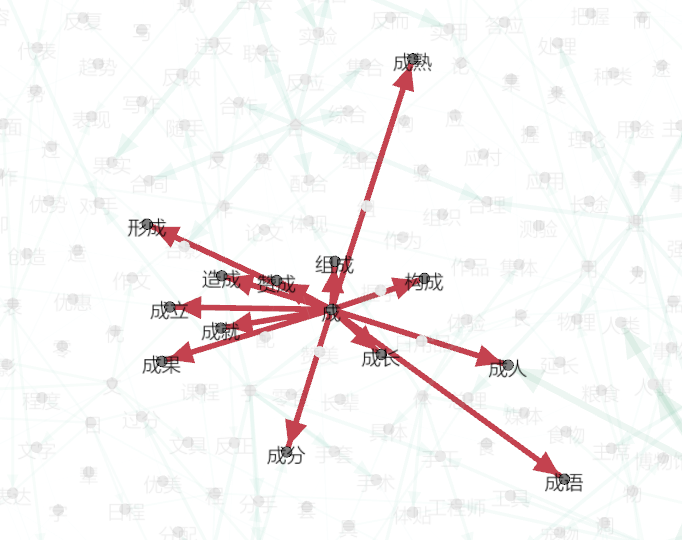
And here is a detail of the graph:


In this graph, outbound edges represent the character contribution as semantic or phonetic component for another hanzi.
It's nice to observe some contributions...let's take for example the character 少 (shao3), with the following outbound edges:


We can observe it contributes to 劣 (lie4) semantically ("bad, inferior") conveying the message of "lower" and to 抄 (chao1) phonetically (as the latter results as a "slight" phonetic variation of shao3).

Besides, when calculating the degree for every node, Gephi reports the following degree distribution:


It suggests that in this set there is a large amount of hanzi contributing to a little portion of the other characters and a really small subset of hanzi contributing to many characters. This observation is confirmed when reading the palette percentages for the nodes out-degree:


Wednesday, 25 April 2018

The HSK5 words graph

Some time ago I faced an incredible challenge: study and pass HSK5.
During the time spent studying, I thought it could be useful to target all the similar words in the HSK5 vocabulary.
It's easy for me to remember chinese pictographs if they have some prominent characteristic but when this prominent characteristic is missing, this task for me can be difficult.

So I developed a small script to show all the HSK5 characters sharing some common component, just for the sake to spot the "similar" one.
Ok, I know that talking about "similarity" with Chinese characters is something deeply different (anyone said "radicals"?), but this is just a naive way to have a representation.

I wrote the script in Python, starting from HSK5 character list: the script basically build a pseudo-adjacency list. Since I wanted to use Gephi for the representation, I used repetitions of characters in the matrix to enforce the weight of the edges in the graph (pretty ugly but fast and visualization-effective!), since Gephi adds the weight on repetition.

Here you can find the sources:

https://github.com/antigones/hsk5_words_graph

Ok, now what it is this graph like? Full resolution here!


Looking at the graph some nice relationships emerge:


Some student asked me to make this graph navigable so I used Gephi to obtain a .gexf file to load in this nice visualizer:

https://github.com/raphv/gexf-js

And here is the link to the final result:

https://antigones.bitbucket.io/projects/hsk5_graph/